

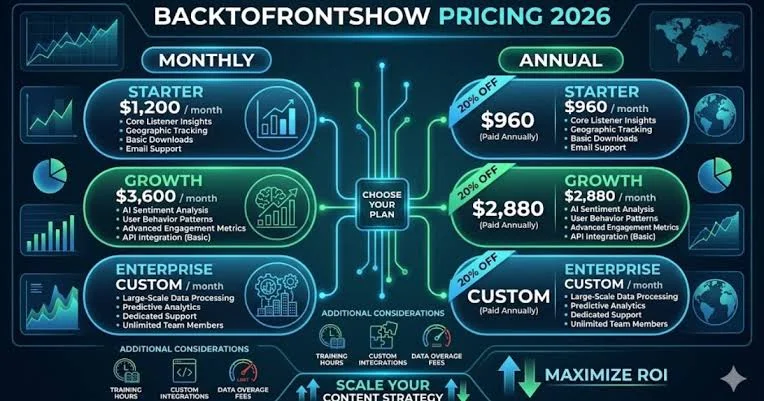
In this digital backtofrontshow pricing world we live in, businesses, content creators, and organizations rely on dedicated platforms to handle presentations, events, audience engagement, and experiences online. Among the hottest terms has been BacktoFrontShow pricing. Regardless of how you learned about this platform — is it for business purpose, events hosting or even presenting your content — you need to prepare accordingly and understand how much money you are expected to pay before investing in this tool.
This guide will cover the costs surrounding BacktoFrontShow pricing, what can influence those costs, other potential pricing models, their benefits and how to decide if BacktoFrontShow is the right for you.
What Is BacktoFrontShow?
BacktoFrontShow is usually related to a digital platform or service that is meant to improve presentations, events, audience engagement and content delivery. Similar to many modern software solutions, it is focused on increasing ease of use while offering professional-grade tools to the users.
Before buying software, questions asked by prospective customers usually include the following 3:
How much does it cost?
What features are included?
Does the value accompany the pricing?
Without these questions, you will never understand the backbone of BacktoFrontShow pricing.
Why Pricing Matters
Among all the factors considered in selecting a digital platform, pricing is often one of the leading considerations. That businesses get their bang for the buck without going over budget.
We have three reasons for this: a transparent pricing structure supports users in both their central and secondary buying interest.
Plan expenses effectively
Compare alternatives
Calculate return on investment (ROI)
Pick the right package according to their needs
Avoid unexpected costs
BacktoFrontShow pricing is particularly significant for organisations that intend to expand their usage during the course of time.
Common Software Pricing Models
Pricing strategies differ by platform, but many digital services utilize similar pricing strategies. With these models, users can better assess BacktoFrontShow pricing.
Subscription-Based Pricing
The most popular model is to charge on a monthly or annual basis.
Benefits include:
Predictable costs
Regular updates
Ongoing customer support
Access to new features
Annual plans usually save you money when compared to monthly billing.
Tiered Pricing
Most software providers have several plans:
Basic
Professional
Business
Enterprise
All of them comprise a combination of features and user allowances per tier.
Pay-As-You-Go
While some platforms bill you for real consumption.
Examples include:
Number of events hosted
Audience size
Storage consumed
Data processed
This model gives an advantage to users whose needs are evolving.
Enterprise Custom Pricing
These large organizations generally need bespoke solutions.
Enterprise pricing may include:
Dedicated support
Advanced security
Custom integrations
Unlimited usage options
Personalized onboarding
These are generally negotiated directly with the provider.
Factors Influencing BacktoFrontShow Pricing
Multiple aspects can impact the overall cost of a platform like BacktoFrontShow.
Number of Users
Most software pricing is based on the number of team members who need access.
Companies have a small business with only one or two accounts, while others are for large organizations that can require dozens or even hundreds.
Feature Availability
Premium features often increase pricing.
Examples may include:
Advanced analytics
Audience engagement tools
Branding customization
Automation capabilities
Integration support
Each user must analyze which features are necessary.
Event Volume
Pricing for BacktoFrontShow (if it works with events or presentations) will be based on how many sessions are held monthly.
You may need to upgrade plans for high levels of activity.
Storage Requirements
Many platforms with recorded events, presentations or media assets store them but often put a storage limit according to price plans.
However, businesses that work with a lot of content may require more storage.
Customer Support Level
How much you will pay for the software can often depend on your support options.
Basic plans may include:
Email support
Knowledge base access
Premium plans may offer:
Live chat
Phone support
Dedicated account managers
Priority response times
Potential Pricing Tiers
While no pricing structures are set in stone, most platforms will define the plans roughly into tiers.
Starter Plan
Made for Individual User/Small team
Typical features include:
Basic functionality
Limited users
Standard support
Entry-level analytics
The most budget-friendly option you can expect.
Professional Plan
Suitable for growing organizations.
Possible features include:
Expanded user limits
Enhanced reporting
Additional integrations
Improved customization
Professional plans are usually the most cost-effective option for anyone who needs all the features of a video conferencing tool.
Business Plan
Designed for larger teams and institutions.
Benefits may include:
Advanced management tools
Team collaboration features
Greater scalability
Premium support
This tier typically caters to companies that require greater operational demands.
Enterprise Plan
Designed for large organizations with complex requests.
Enterprise-level features may include:
Custom workflows
Enhanced security
Dedicated infrastructure
Service-level agreements (SLAs)
Strategic account support
Pricing is often customized by the organization.
Evaluating Cost Versus Value
Software should never be evaluated on price alone.
Instead, the users have to assess the overall value delivered.
Questions to ask include:
Does it save time?
Does it improve productivity?
Can it increase revenue?
Does it enhance audience engagement?
Will it reduce manual work?
And sometimes what looks to be a more expensive solution might ultimately give you the better long-term savings and performance.
Benefits That May Justify Pricing
The advantages of premium platforms mean that many businesses happily spend their cash in these systems.
Improved Efficiency
Automation and a more streamlined workflow can lessen your administrative burden.
Less time managing processes, and more time concentrating on strategic goals.
Better User Experience
Now, in the present day and age, this function normally upgrades audience commitment.
Interactive tools, live feedback, and analytics contribute to forming close connections with the participants.
Scalability
When an organization grows, so do its software needs.
A scalable platform enables increased usage without integrating across multiple systems.
Data Insights
Organizations rely upon advanced reporting for a thorough and holistic understanding of performance metrics.
It can help establish a foundation for decision-making and lead to better results next time.
Comparing BacktoFrontShow Pricing to Competitors
Whenever exploring a software solution, it is necessary to research alternative options.
Potential comparison criteria include:
Factor
Importance
Monthly Cost
High
Feature Set
High
Scalability
Medium
Customer Support
High
Security Features
High
Integration Options
Medium
Ease of Use
High
Most of the time, the cheapest option is not the right one. The companies that are able to see beyond the price and into value and longevity will do much better.
Choosing the Right Plan: Tips
Understand Your Requirements
Prepare a list of must-have features before looking at pricing plans.
So it prevents you from buying things that you don 39 t need.
Estimate Future Growth
How will your needs change in the course of a year?
Choosing a growth-enabled plan will save you from an expensive migration in the future.
Use Free Trials
Most of the software providers will provide you trial for free.
By trying it out, users can assess the following:
Ease of use
Feature quality
Performance
Support responsiveness
Calculate ROI
Before spending significant resources developing any software, you should first verify whether it can deliver savings or revenue on top of your existing capacity.
The investment could pay for itself in a matter of weeks if the platform saves staff several hours per week.
Hidden Costs to Watch For
Users should also check out any fees that might be applicable when examining BacktoFrontShow pricing information.
Examples include:
Setup fees
Training costs
Additional user licenses
Premium integrations
Storage upgrades
Custom development services
How affordable is online education really, through TCO Total Cost of Ownership?
The Future of Software Pricing
Software pricing is still evolving as software providers respond to new customer expectations.
Current trends include:
Flexible subscriptions
Usage-based billing
AI-powered feature packages
Personalized enterprise plans
Bundled service offerings
Platforms that provide transparent pricing and have scalable options tend to bring in a wider customer base.
Conclusion
BacktoFrontShow pricing is more than just a monthly subscription fee. This is where things like feature availability, scalability, support options, storage requirements, and overall pricing come into play, which people must assess before making a decision.
The best pricing plan is the one that satisfies your requirements and has all functionality to grow with you in future. After all, by comparing plans to understand what is offered, calculating ROI and weighing long-term benefits, users can make smart buying decisions and stretch their budget as far as possible.
With the ever-changing landscape of telecoms, the choice is not simply price vs service potential success: you want a solution to be affordable, performant and ultimately successful for years to come.